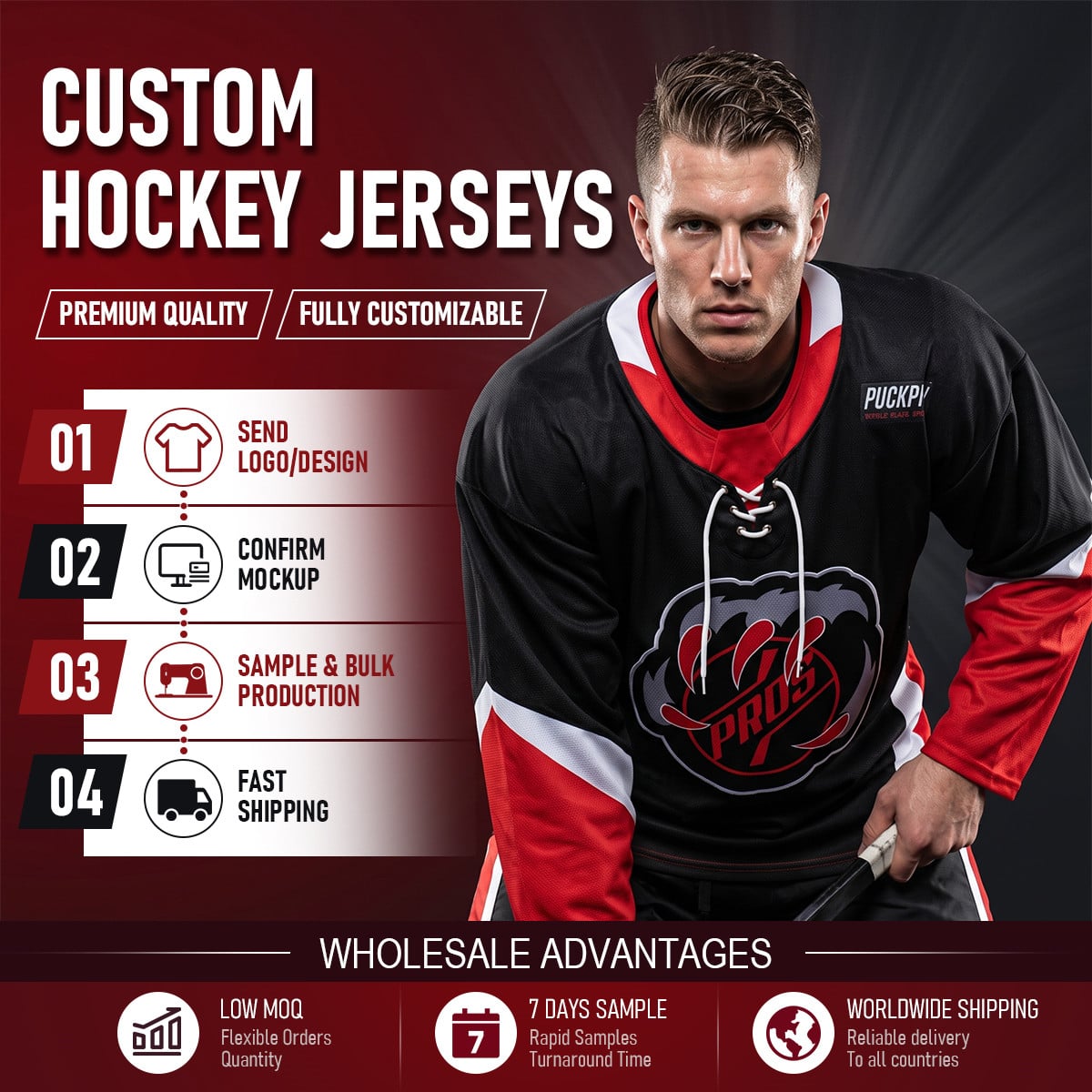
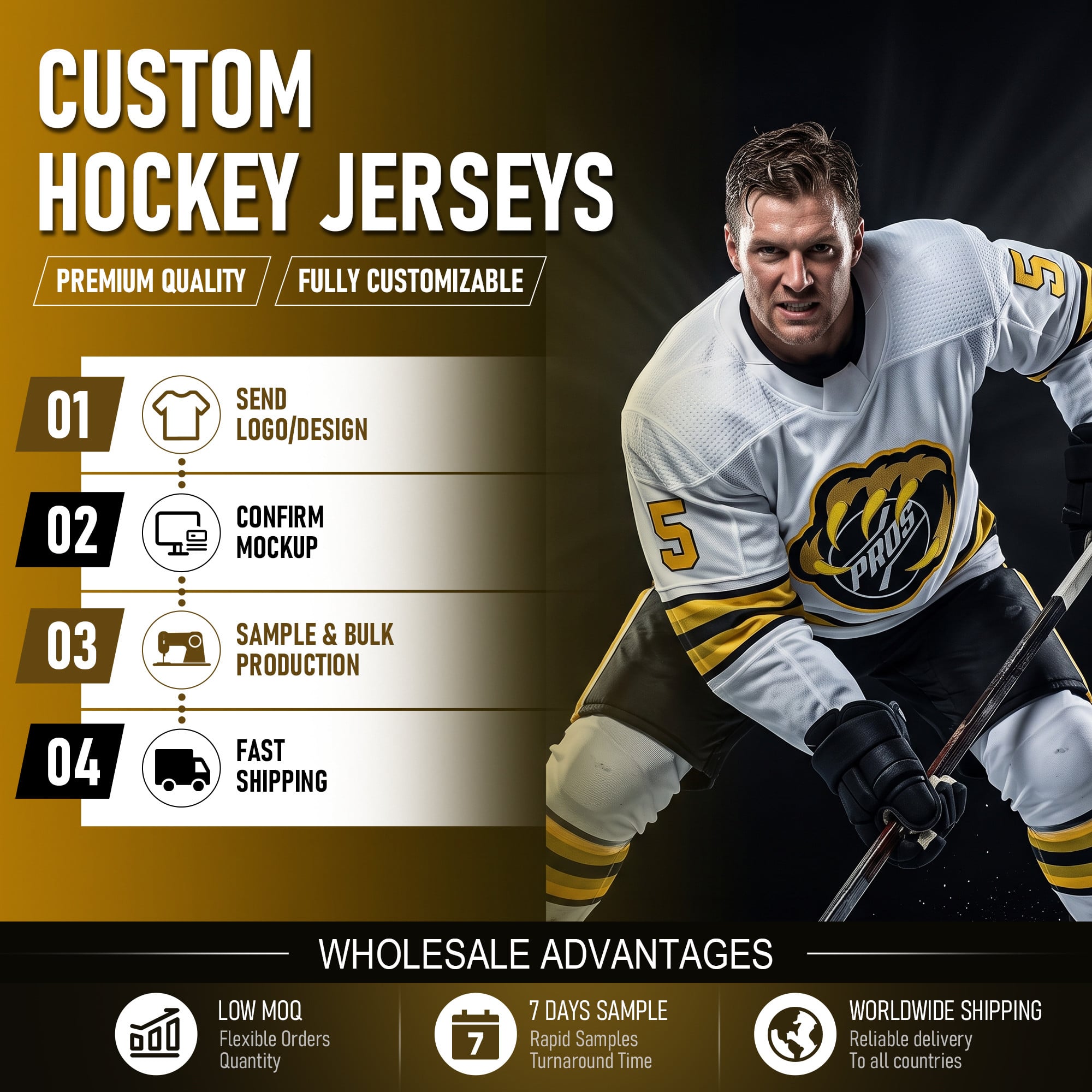
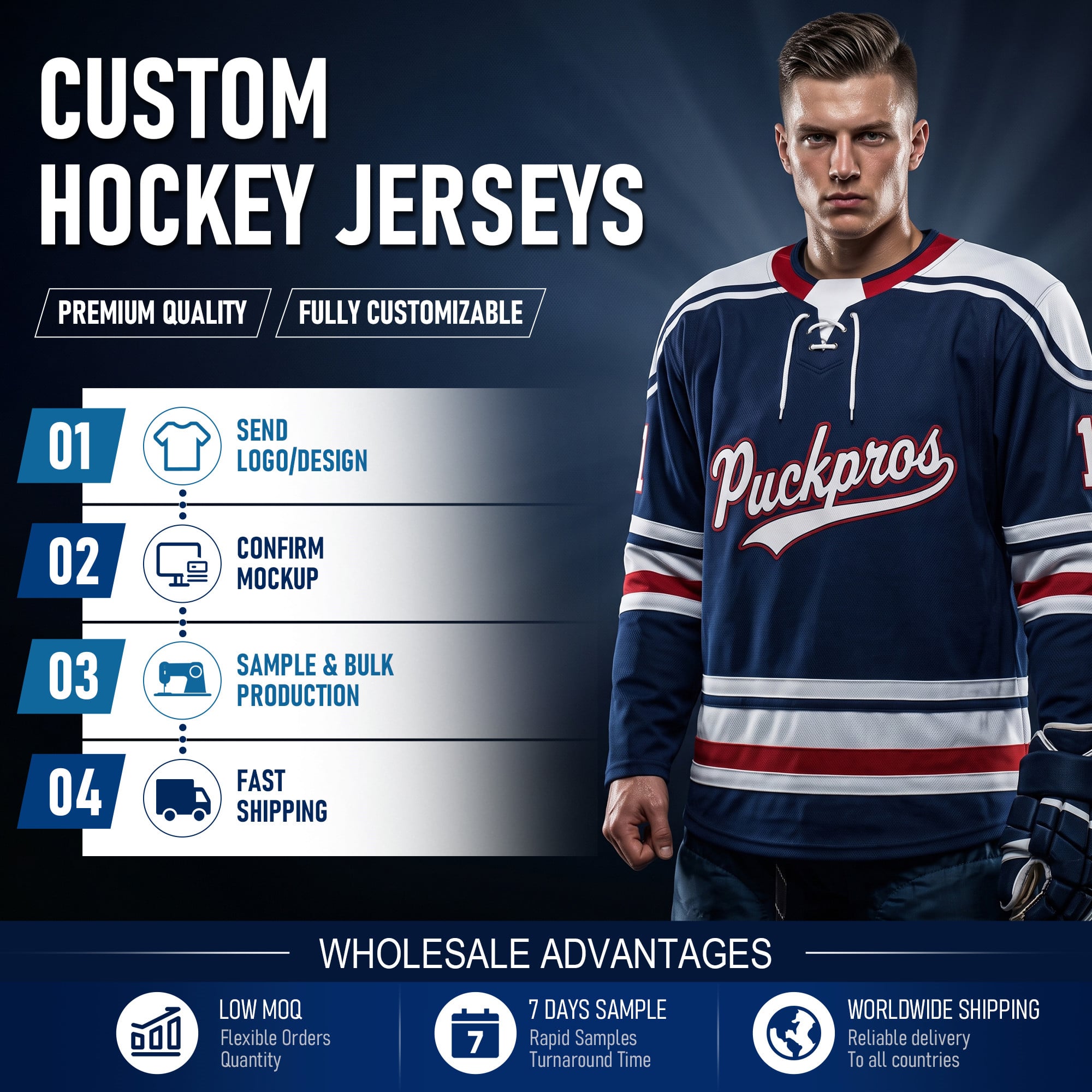
Every conversation about a custom hockey jersey starts with the design and ends with the fabric. Coaches talk about color and crest; players talk about how the jersey feels on the second shift, when the collar is wet and the sleeves are heavy. Both are decided long before the first print, in a fabric selection that most buyers never see. PUCKPROS keeps six jersey fabrics in its standard range, built at two weights, and each one solves a different problem. This is what they are, what they weigh, and how to pick the right one for your team.
Jersey fabric is measured in grams per square meter, and the number tells you more than any marketing adjective. Our range splits cleanly into 160 gsm and 220 gsm. The lighter group is built for speed and heat: it moves freely, dries fast and keeps a player comfortable in a warm training hall or a fast, high-tempo game. The heavier group is built for contact and durability: denser mesh, more structure, and a hand that holds its shape through a season of board battles.
Neither weight is better in the abstract. A 220 gsm jersey worn by a peewee team in a cold rink is wasted mass; a 160 gsm jersey issued to a checking line that plays forty games feels thin by February. The right answer comes from how your team plays and where it plays, not from a spec sheet alone.
All six are 100% high-strength polyester mesh. Polyester is the fiber that both survives hockey and accepts dye sublimation properly, which is why every jersey we print is built on it. What changes from fabric to fabric is the knit structure, and that is where the differences live.
Every fabric in the range carries the same five guarantees, because they are properties of the construction rather than of a single weave: certified recycled content under the Global Recycled Standard, breathable quick-drying performance, wear- and tear-resistance for board contact, anti-pilling and anti-fade behavior after repeated washing, and wrinkle-free easy-care handling out of the dryer.
Four questions narrow the range faster than any catalog browsing.
Fabric is verified before production, not after. Our quality team checks weight, yarn count, colorfastness and breathability against the approved sample, and every roll is matched to the order before it reaches the printing room. A jersey printed on the wrong lot of fabric can look correct on day one and shrink into a different size by the end of the season, which is why the check happens at the roll, not at the carton.
Two proprietary constructions sit on top of this range for teams that want more. Vortex-Mesh 3D adds up to 33.5% more breathability than conventional sportswear, and Armor-Pit laminated panels raise tear resistance by 46.8% in the zones that take the most abrasion. Both are proven through repeated machine washing rather than in a single lab pass.
Numbers describe a fabric; hands judge it. When your sample arrives, do three things. Fold the jersey in half and press the crease: a good knit releases the fold, a cheap one keeps the line. Stretch the side panel and let go: it should recover, not sag. Then hold it up to the light: you should see an even mesh, not thin spots where the yarn count drops.
Those three checks tell you more about a jersey's third season than any photograph, and they take less than a minute at the rink.
A design can be redrawn and a crest can be restitched. A fabric choice is locked in for the life of the order, which is why we keep six options instead of one, and why we ask how your team plays before we quote a weight. Tell us the rink, the level and the schedule, and we will name the fabric that fits, send a swatch, and print your design on it so you can see the two together.
Your brand. Our factory.
 Hot News
2026-11-18
2026-11-23
2026-11-21
2026-11-16
2026-11-13
2026-11-11

PUCKPROS is a designer & manufacturer specializing in team hockey jerseys for 12 years. We have provided customized services for over 1,500 hockey teams.
Mars Space 206, No. 366 Heng'an Road, Hongshan District, Wuhan City, Hubei Province, China
Copyright © Wuhan Puckpros Sporting Goods Co.,Ltd All Rights Reserved - Privacy Policy - Blog
 EN