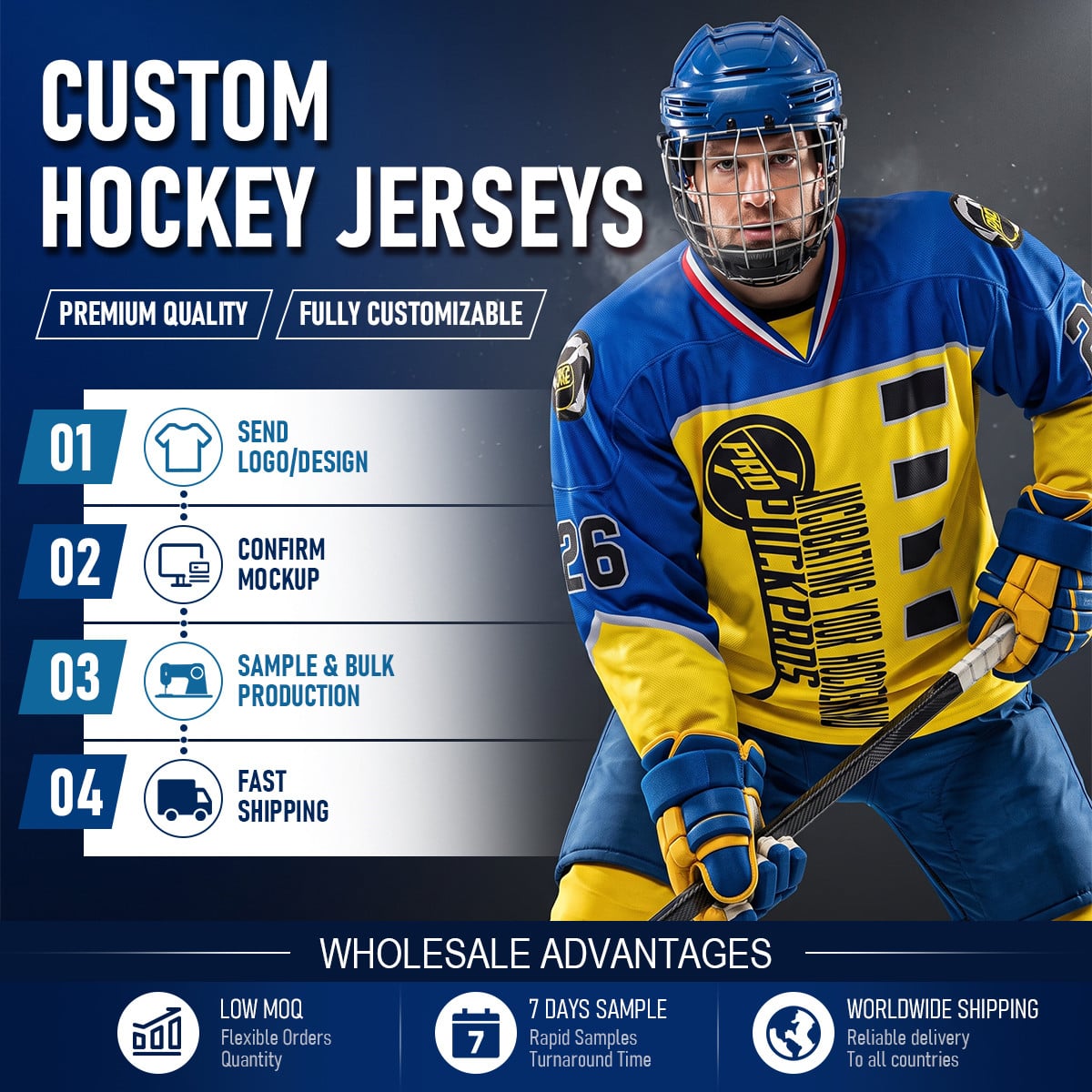
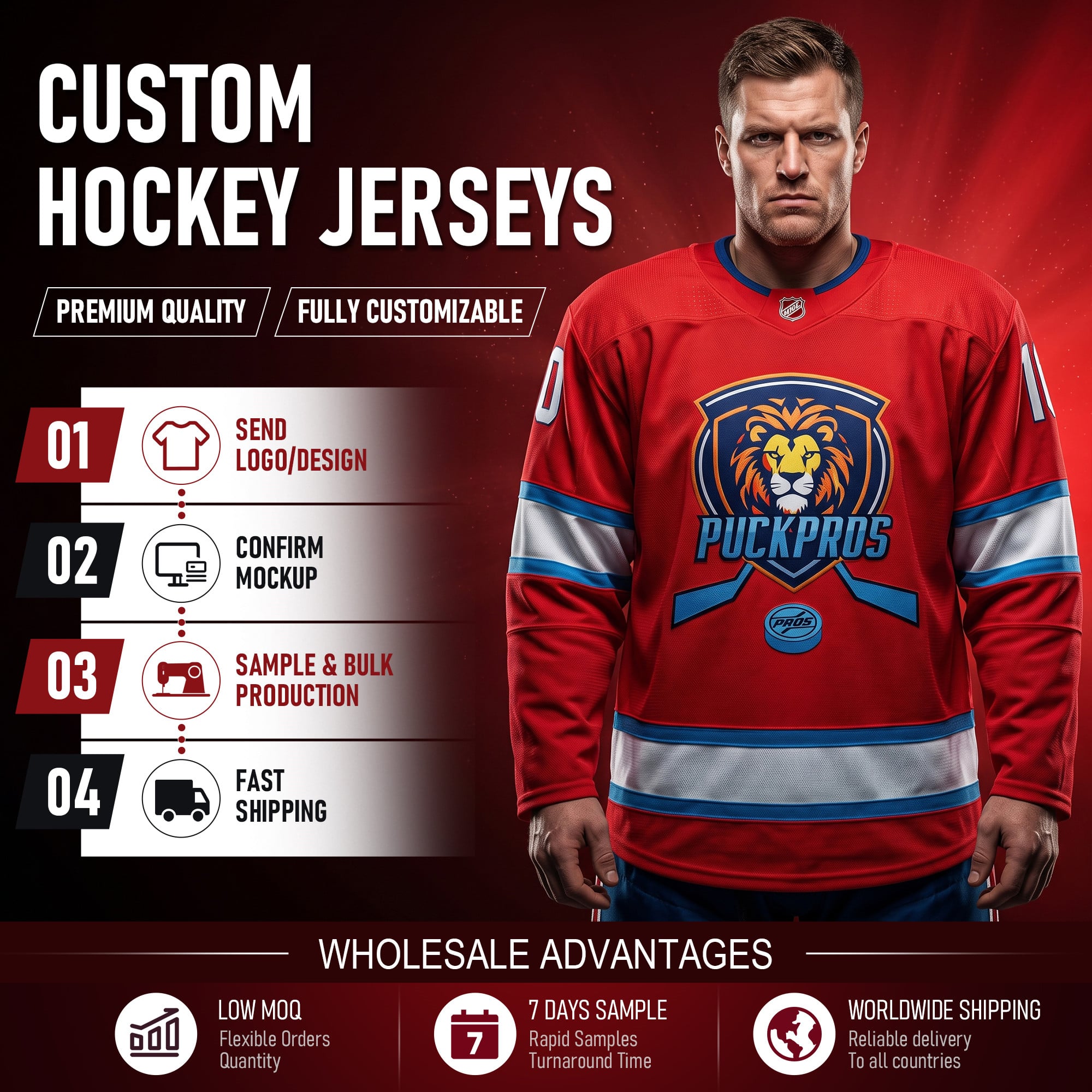
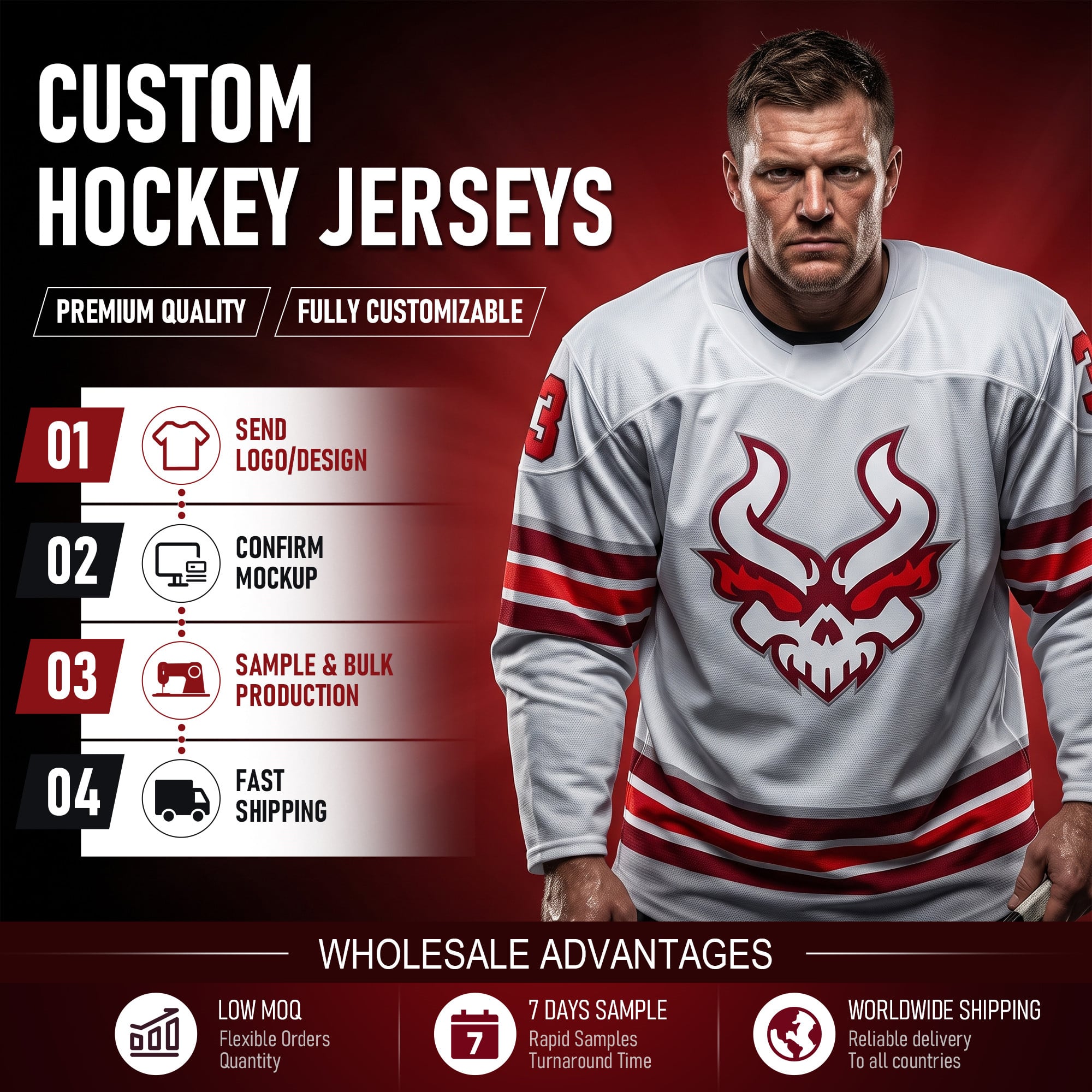
Ask around long enough about custom hockey jerseys and you will hear the same phrase: “it is a heat press jersey.” It sounds technical, it is repeated everywhere, and for most factories it is simply wrong. At PUCKPROS the heat press touches exactly one element of your jersey: a strip of label roughly the size of a postage stamp at the back of the neck. Everything else, the body color, the stripes, the shoulder pattern, the player name, the back number and the sleeve number, is produced by dye sublimation transfer printing. That distinction decides how your jersey looks in its third season, not only on delivery day. This article follows the eleven steps a PUCKPROS jersey actually passes through and explains which craft does which job.
Every jersey that leaves our floor follows the same route. The sequence is not decoration; each stage exists because the next stage depends on it.
Sublimation is not printing on top of fabric; it is printing inside it. The ink is a solid that becomes gas at transfer temperature, around 200 degrees Celsius, and then re-solidifies within the polyester fiber. Because the color becomes part of the yarn, there is no surface layer to crack, peel or gray out at the edges. A player who takes a check into the boards does not chip the number on his back. A jersey washed twice a week for a full season does not develop a white crack line down the crest of the chest.
Two practical consequences matter to a team buyer. First, names and numbers are part of the same print as the body, which means the white of the number is the same white as the shoulder stripe, the outline matches the trim, and no number sits on a separate film that can lift at the edge. Second, no weight is added and no pore is blocked, so a fully printed jersey breathes like greige fabric and dries quickly after a game.
Sublimation also solves a design problem that other methods cannot: gradients, halftones, fine line work, animal prints, city skylines and photographic textures all reproduce without screens, color separations or per-color setup. A design with twelve colors costs the same to print as a design with two, because there is no second pass and no second plate.
A stitched crest is the one place on a jersey where thread, not ink, makes the mark. Crest panels arrive at the embroidery floor flat, which is the only way to hold registration cleanly: the badge is centered on the panel before the panel becomes a chest. Multi-head machines run the outline, the fill and the detail passes, with stitch density and backing chosen for the badge geometry rather than for speed.
The result is texture you can feel at arm's length and a badge that survives industrial washing, pulling and abrasion far longer than a print can. That is why clubs put the crest in thread and leave the rest of the design to ink: each craft handles the job it is actually good at.
The chart we quote from has three routes for each element of the jersey, and they are not interchangeable in look, weight or lead time. Choosing well is a matter of knowing what each route does.
Crest. Sublimated: printed into the panel in the same pass as the body, with no thread and no edge, the lightest and the most faithful to gradients. Printed-twill: the artwork is printed onto twill fabric, cut to shape and stitched down, which gives a layered, slightly raised badge with a stitched border. Embroidered: the badge is built stitch by stitch in thread, the heaviest and the most tactile, and the most durable under abrasion.
Number. Sublimated numbers are part of the body print: same white, same ink, no film, and the reverse of the fabric shows the color through. Tackle-twill numbers are cut from solid-color twill, layered and sewn, the traditional pro look, with a real edge you can feel. Printed-twill numbers sit between the two: full-color print on twill, cut and stitched, sharper detail than tackle twill at a lighter weight.
Name. The same three options, and the same logic. A sublimated nameplate is invisible to the touch and never lifts. A twill name is a separate piece of fabric, sewn on, with an edge that is part of the look.
Our default for team orders is the lightest combination: sublimated body, sublimated names and numbers, and a crest in whichever of the three routes the club prefers. If you want the stitched look, say so at the quote stage, because twill and embroidery add cutting and sewing steps and therefore days, not just dollars.
The label at the back of the neck carries the brand mark, the size, the fiber content and the care instructions. It has to be legible after fifty washes, flat against bare skin, and thin enough that a player never notices it. A woven label sewn into the collar leaves a seam ridge against the neck; a printed label fades and disappears.
A heat transfer label solves all three requirements at once. The label is pressed onto the collar piece at roughly 150 to 160 degrees Celsius for 10 to 20 seconds; the carrier film releases the ink onto the fabric and is peeled away, leaving a soft, thin, edge-free mark. Because it is applied before sewing, the position is locked to the pattern, not eyeballed by an operator at the end of the line. This is the step the phrase “heat press jersey” actually describes, and it covers a patch smaller than a business card.
Take a single order: a peewee club, twenty-two players, navy body, white and silver trim, sublimated names and numbers, embroidered crest, heat transfer neck label. On day one the artwork is separated per player and printed on transfer paper. On day two the paper runs through the calender and the printed fabric is cut, sorted and stacked by player. The crest panels go to embroidery the same day they are cut, while they are still flat. The neck label is pressed onto the collar pieces next, then the panels go to sewing, where shoulders, sleeves and hems are joined. Ironing and finishing settle the seams, quality control measures each jersey against the order sheet, and packaging folds them in size order so the coach can hand them out at the rink without sorting.
Nothing in that sequence is unusual, and that is the point. The order is fixed, the handoffs are fixed, and the only variable is how many jerseys are in the queue.
The process above is not a description of good intentions; it is a description of equipment. Our floor runs 99 machines: six digital printing machines that output the sublimation transfer paper, nine laser cutters, eleven embroidery machines and seventy-three sewing machines, split across production lines so that printing, cutting, embroidery, label pressing and sewing each have dedicated capacity. Our facility is SGS-certified, and every order passes through the same eleven checkpoints regardless of size.
Capacity matters because it removes the shortcuts that damage custom work. When printing capacity is short, factories press numbers on instead of printing them. When embroidery is outsourced, crests land on a different schedule than panels and the line waits. Keeping all four crafts under one roof is how a jersey gets its design, its crest and its label on the same timetable.
If you are ordering custom jerseys, the practical takeaway is simple. The body of your jersey should be sublimated, all over, in one print, with the names and numbers included in that print. The crest should be embroidered if you want texture and longevity. The neck label should be a heat transfer, because that is the only place it belongs.
Because the whole design prints in one pass, you can put a gradient behind the number, a pattern inside the sleeve stripe and a photographic skyline across the chest without adding cost or weight. Because names and numbers print with the body, a mid-season replacement player can be produced from the same file with the same color, and the new jersey will not look like a different generation of the kit.
We build a sample before bulk production so you can judge the print under your own light, feel the crest with your own hands and run a thumb across the neck label. If the sample is right, the run is right, because nothing between the sample and the run changes except the quantity.
Send us your artwork, your roster and your size run. Our designers will return a digital proof, flag anything that will not print cleanly at game size, and quote the run. Your brand. Our factory. That is the whole arrangement: the design stays yours, the eleven steps stay ours.
 Hot News
2026-11-18
2026-11-23
2026-11-21
2026-11-16
2026-11-13
2026-11-11

PUCKPROS is a designer & manufacturer specializing in team hockey jerseys for 12 years. We have provided customized services for over 1,500 hockey teams.
Mars Space 206, No. 366 Heng'an Road, Hongshan District, Wuhan City, Hubei Province, China
Copyright © Wuhan Puckpros Sporting Goods Co.,Ltd All Rights Reserved - Privacy Policy - Blog
 EN