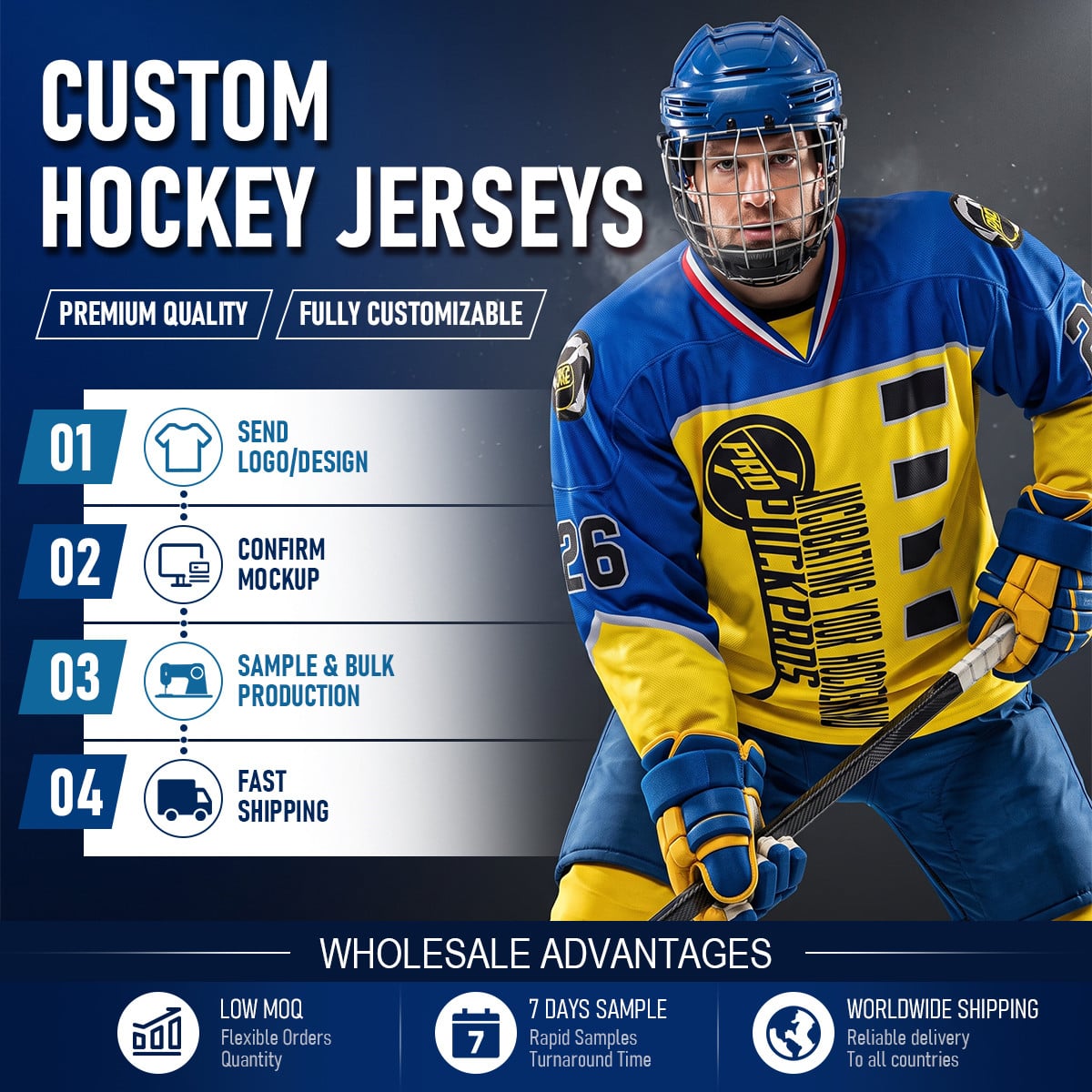
Every hockey player knows the disappointment of a jersey that loses its sparkle: colors that fade to pastel, prints that crack at the seams, numbers that peel after a dozen washes. It doesn't have to be that way. At PUCKPROS, our jerseys use dye sublimation — a technology that makes the color part of the fabric itself. Here's the science behind why sublimated jerseys keep their game-day glow for years.
Dye sublimation is a printing method built for performance fabrics. A design is printed onto special transfer paper using sublimation inks, then the paper and the fabric run together through a calender transfer machine. Under heat and pressure, the ink turns to gas and moves from the paper into the polyester fabric — permanently. It's the same technology behind full-color team jerseys, socks and practice gear around the world.
The word "sublimation" describes the star of the show: the dye skips the liquid phase. Inside the transfer calender at roughly 175–205°C, the solid ink turns directly into a gas. That gas penetrates the open pores of the polyester fibers and, as the fabric cools, re-solidifies inside them. The color is no longer on the fabric — it's in the fabric, bonded at a molecular level.
Because there's no surface layer, there's nothing to crack, peel or scratch off:
Sublimation gives designers a full canvas: edge-to-edge graphics, smooth gradients, fine lines and even fluorescent and neon colors matched to the Pantone system. And because the ink doesn't add a physical layer, the fabric keeps its breathability and weight — no stiff print, no extra grams, no airflow blocked. For players, that means identity and performance in one jersey.
Sublimation is ideal for 100% polyester products: game jerseys, training jerseys, socks and shells. At PUCKPROS, our 6 high-precision digital printing machines are dedicated to full sublimation output, with every print inspected for color accuracy and adhesion before it moves down the line.
It helps to compare sublimation with the older approach, screen printing. Screen printing lays a layer of ink on the fabric surface — bold colors, but a print that sits on top: it can crack when the jersey flexes, peel at high-wear zones and add stiffness to the fabric. Sublimation has none of those drawbacks for polyester gear. That's why modern hockey jerseys, socks and shells have moved to sublimation: the color is part of the fabric, so there is no layer to lose. For 100% polyester performance apparel, sublimation isn't just an upgrade — it's the standard.
The next time you pull on a jersey that still looks brand new after a full season, you're seeing sublimation at work. It's why our colors never crack, peel or fade — and why teams keep coming back. Send us your artwork, and let's put it on a jersey that will never lose its edge.
 Hot News
2026-11-18
2026-11-23
2026-11-21
2026-11-16
2026-11-13
2026-11-11

PUCKPROS is a designer & manufacturer specializing in team hockey jerseys for 12 years. We have provided customized services for over 1,500 hockey teams.
Mars Space 206, No. 366 Heng'an Road, Hongshan District, Wuhan City, Hubei Province, China
Copyright © Wuhan Puckpros Sporting Goods Co.,Ltd All Rights Reserved - Privacy Policy - Blog
 EN